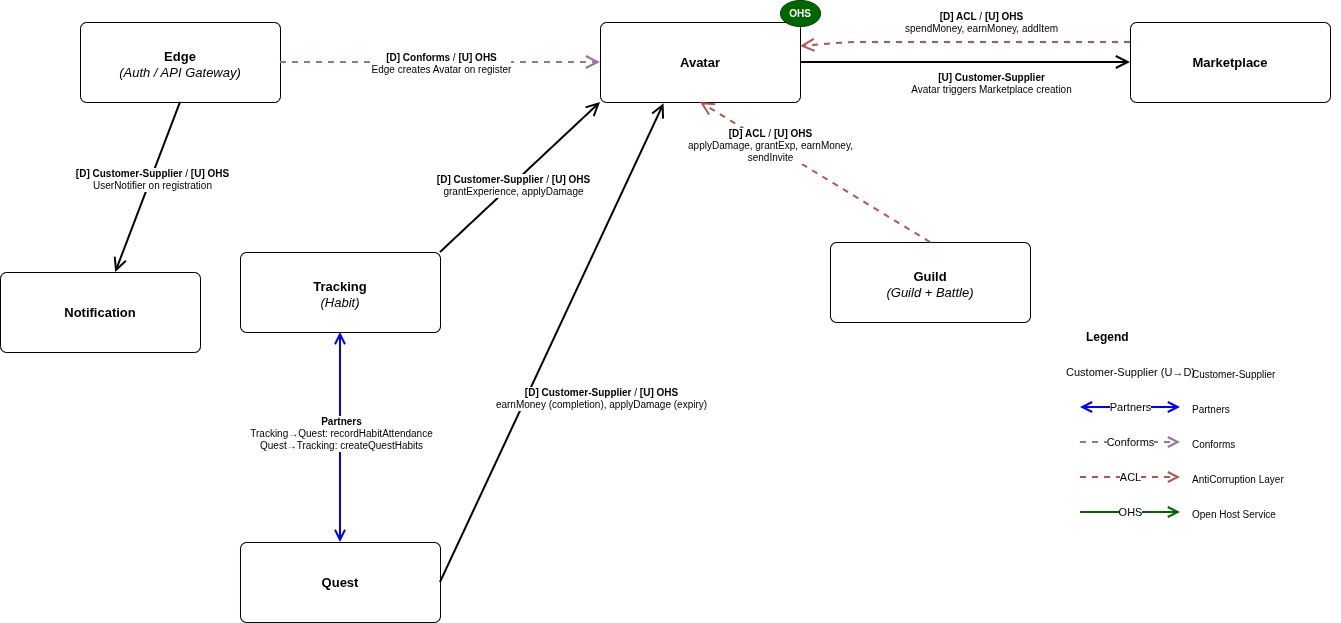
Context Map
Avatar is the central bounded context and acts as an upstream for most of the system.
It exposes a stable REST API that all other contexts consume, hiding its real internal representation, so it's considered an Open Host Service (OHS).
The mapped relationships are:
-
Edge → Avatar — Conformist [D] / OHS [U]: During registration, the Edge calls the Avatar sending the user ID for Avatar creation. Edge adapts to Avatar’s model.
-
Edge → Notification — Customer-Supplier[U→D]: AuthService uses UserNotifier to trigger a registration notification. This is a unidirectional relationship where Notification is a stable supplier.
-
Avatar → Marketplace — Customer-Supplier [U→D]: During avatar creation, a corresponding Marketplace is created. Avatar drives the Marketplace lifecycle.
-
Marketplace → Avatar — Anti-Corruption Layer (ACL) [D] / OHS [U]: Marketplace translates its internal concepts of Money and Item into Avatar calls via the port interface. The port acts as an anti-corruption layer isolating the internal model.
-
Guild → Avatar — Anti-Corruption Layer (ACL) [D] / OHS [U]: The Guild translate battle/guild concepts (damage, rewards, invitations) into calls to the Avatar model.
-
Tracking → Avatar — Customer-Supplier [D] / OHS [U]: Tracking send calls to grant experience and apply damage on Avatar. No significant translation, just a simple downstream dependency.
-
Tracking ⟷ Quest — Partners: Coordinated bidirectional integration. Tracking calls to record habit attendance when a habit is completed. Quest calls to create quest habits, when an avatar joins a quest.
-
Quest → Avatar — Customer-Supplier [D] / OHS [U]: Quest calls the avatar to earn money on completion, and calls apply damage when a quest expires.